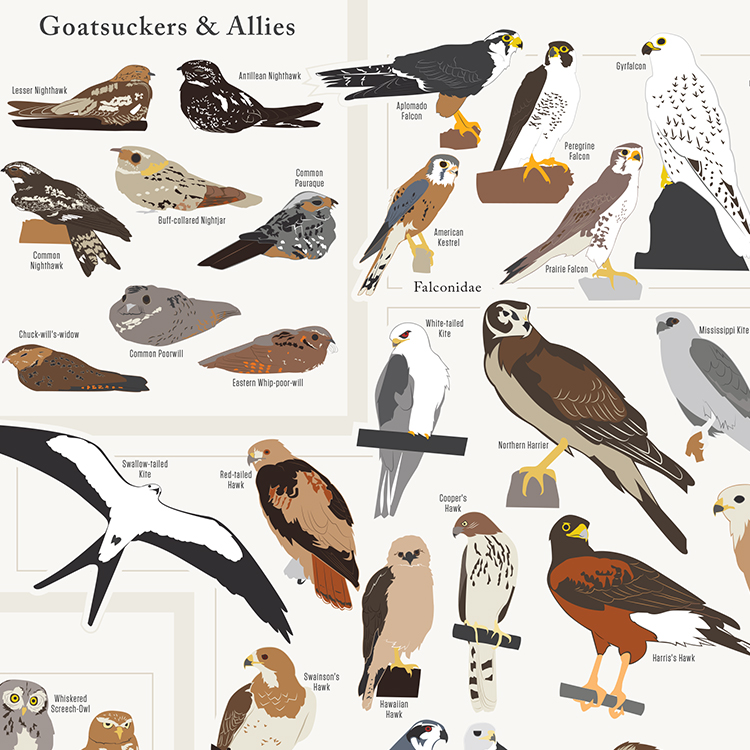
The lists of birds in the light blue box below are divided by biological family. The lists are based on The AOS Check-list of North American Birds of the American Ornithological Society and The Clements Checklist of Birds of the World supplemented with checklists from Panama, Greenland, and Bermuda. It includes the birds of Greenland, Canada, the United States (excluding Hawaii), Mexico, Central America, Bermuda, and the West Indies.
Taxonomy
The taxonomic treatment (designation and sequence of orders, families and species) and nomenclature (common and scientific names) used in the accompanying bird lists adheres to the conventions of the AOS's (2019) Check-list of North American Birds, the recognized scientific authority on the taxonomy and nomenclature of North America birds. The AOS's Committee on Classification and Nomenclature, the body responsible for maintaining and updating the Check-list, "strongly and unanimously continues to endorse the biological species concept (BSC), in which species are considered to be genetically cohesive groups of populations that are reproductively isolated from other such groups" (AOS 2019). The Sibley-Ahlquist taxonomy is an alternative phylogenetic arrangement based on DNA-DNA hybridization.
Unless otherwise noted, all species listed below are considered to occur regularly in North America as permanent residents, summer or winter residents or visitors, or migrants. The following codes are used to denote certain categories of species:
- (A) = Accidental occurrence based on one or two (rarely more) records, and unlikely to occur regularly.
- (E) = Extinct; a recent member of the avifauna that no longer exists.
- (Ex) = Extirpated; no longer occurs in area of interest, but other populations still exist elsewhere.
- (I) = Introduced population established solely as result of direct or indirect human intervention; synonymous with non-native and non-indigenous.
Conservation status - IUCN Red List of Threatened Species:
- EX - Extinct, EW - Extinct in the Wild
- CR - Critically Endangered, EN - Endangered, VU - Vulnerable
- NT - Near Threatened, LC - Least Concern
- (v. 2019, the data is current as of July 25, 2019
and Endangered Species Act:
- E - endangered, T - threatened
- XN, XE - experimental non essential or essential population
- E(S/A), T(S/A) - endangered or threatened due to similarity of appearance
- (including taxa not necessarily found in the USA, the data is current as of March 28, 2014
Tinamous
Order: Tinamiformes Family: Tinamidae
The tinamous are one of the most ancient groups of bird. Although they look similar to other ground-dwelling birds like quail and grouse, they have no close relatives and are classified as a single family, Tinamidae, within their own order, the Tinamiformes. They are related to the ratites (order Struthioniformes), which includes the rheas, emus, and kiwis.
- Highland tinamou, Nothocercus bonapartei LC
- Great tinamou, Tinamus major NT
- Little tinamou, Crypturellus soui LC
- Thicket tinamou, Crypturellus cinnamomeus LC
- Slaty-breasted tinamou, Crypturellus boucardi LC
- Choco tinamou, Crypturellus kerriae VU
Screamers
Order: Anseriformes Family: Anhimidae
The screamers are a small family of birds related to the ducks. They are large, bulky birds, with a small downy head, long legs, and large feet which are only partially webbed. They have large spurs on their wings which are used in fights over mates and in territorial disputes.
- Horned screamer, Anhima cornuta (E?) LC
- Northern screamer, Chauna chavaria (A) NT
Ducks, geese, and waterfowl
Order: Anseriformes Family: Anatidae
The family Anatidae includes the ducks and most duck-like waterfowl, such as geese and swans. These birds are adapted to an aquatic existence with webbed feet, flattened bills, and feathers that are excellent at shedding water due to special oils.
Guans, chachalacas, and curassows
Order: Galliformes Family: Cracidae
The chachalacas, guans and curassows are birds in the family Cracidae. These are large birds, similar in general appearance to turkeys. The guans and curassows live in trees, but the smaller chachalacas are found in more open scrubby habitats. They are generally dull-plumaged, but the curassows and some guans have colorful facial ornaments.
- Baudo guan, Penelope ortoni (A) EN
- Black guan, Chamaepetes unicolor LC
- Crested guan, Penelope purpurascens LC
- Gray-headed chachalaca, Ortalis cinereiceps LC
- Great curassow, Crax rubra VU
- Highland guan, Penelopina nigra VU
- Horned guan, Oreophasis derbianus EN E
- Plain chachalaca, Ortalis vetula LC
- Rufous-bellied chachalaca, Ortalis wagleri LC
- Rufous-vented chachalaca, Ortalis ruficauda LC
- Trinidad piping guan, Pipile pipile CR
- West Mexican chachalaca, Ortalis poliocephala LC
- White-bellied chachalaca, Ortalis leucogastra LC
Guineafowl
Order: Galliformes Family: Numididae
Guineafowl are a group of African, seed-eating, ground-nesting birds that resemble partridges, but with featherless heads and spangled grey plumage.
- Helmeted guineafowl, Numida meleagris (I) LC
New World quail
Order: Galliformes Family: Odontophoridae
The New World quails are small, plump terrestrial birds only distantly related to the quails of the Old World, but named for their similar appearance and habits.
Pheasants, grouse, and allies
Order: Galliformes Family: Phasianidae
Phasianidae consists of the pheasants and their allies. These are terrestrial species, variable in size but generally plump with broad relatively short wings. Many species are gamebirds or have been domesticated as a food source for humans.
Flamingos
Order: Phoenicopteriformes Family: Phoenicopteridae
Flamingos (genus Phoenicopterus monotypic in family Phoenicopteridae) are gregarious wading birds, usually 3 to 5 feet (0.9 to 1.5 m) tall, found in both the Western and Eastern Hemispheres. Flamingos filter-feed on shellfish and algae. Their oddly-shaped beaks are specially adapted to separate mud and silt from the food they consume and, uniquely, are used upside-down.
- American flamingo, Phoenicopterus ruber LC
Grebes
Order: Podicipediformes Family: Podicipedidae
Grebes are small to medium-sized diving birds. They breed on fresh water, but often visit the sea when migrating and in winter. They have lobed toes and are excellent swimmers and divers; however, their feet are placed far back on their bodies, making them quite ungainly on land.
- Atitlan grebe, Podilymbus gigas (E) EX E
- Eared grebe, Podiceps nigricollis LC
- Clark's grebe, Aechmophorus clarkii LC
- Horned grebe, Podiceps auritus VU
- Least grebe, Tachybaptus dominicus LC
- Pied-billed grebe, Podilymbus podiceps LC
- Red-necked grebe, Podiceps grisegena LC
- Western grebe, Aechmophorus occidentalis LC
Pigeons and doves
Order: Columbiformes Family: Columbidae
Pigeons and doves are stout-bodied birds with short necks and short slender bills with a fleshy cere.
Sandgrouse
Order: Pterocliformes Family: Pteroclidae
Sandgrouse have small, pigeon like heads and necks, but sturdy compact bodies. They have long pointed wings and sometimes tails and a fast direct flight. Flocks fly to watering holes at dawn and dusk. Their legs are feathered down to the toes.
Cuckoos
Order: Cuculiformes Family: Cuculidae
The family Cuculidae includes cuckoos, roadrunners and anis. These birds are of variable size with slender bodies, long tails and strong legs.
Nightjars and allies
Order: Caprimulgiformes Family: Caprimulgidae
Nightjars are medium-sized nocturnal birds that usually nest on the ground. They have long wings, short legs and very short bills. Most have small feet, of little use for walking, and long pointed wings. Their soft plumage is cryptically coloured to resemble bark or leaves.
Oilbird
Order: Steatornithiformes Family: Steatornithidae
The oilbird is a slim, long-winged bird related to the nightjars. It is nocturnal and a specialist feeder on the fruit of the oil palm.
- Oilbird, Steatornis caripensis LC
Potoos
Order: Nyctibiiformes Family: Nyctibiidae
The potoos (sometimes called poor-me-ones) are large near passerine birds related to the nightjars and frogmouths. They are nocturnal insectivores which lack the bristles around the mouth found in the true nightjars.
- Common potoo, Nyctibius griseus LC
- Great potoo, Nyctibius grandis LC
- Northern potoo, Nyctibius jamaicensis LC
Swifts
Order: Apodiformes Family: Apodidae
The swifts are small birds which spend the majority of their lives flying. These birds have very short legs and never settle voluntarily on the ground, perching instead only on vertical surfaces. Many swifts have long swept-back wings which resemble a crescent or boomerang.
Hummingbirds
Order: Apodiformes Family: Trochilidae
Hummingbirds are small birds capable of hovering in mid-air due to the rapid flapping of their wings. They are the only birds that can fly backwards.
Rails, gallinules and coots
Order: Gruiformes Family: Rallidae
Rallidae is a large family of small to medium-sized birds which includes the rails, crakes, coots and gallinules. The most typical family members occupy dense vegetation in damp environments near lakes, swamps or rivers. In general they are shy and secretive birds, making them difficult to observe. Most species have strong legs and long toes which are well adapted to soft uneven surfaces. They tend to have short, rounded wings and to be weak fliers.
Finfoots
Order: Gruiformes Family: Heliornithidae
Heliornithidae is a small family of tropical birds with webbed lobes on their feet similar to those of grebes and coots.
- Sungrebe, Heliornis fulica LC
Limpkin
Order: Gruiformes Family: Aramidae
The limpkin is an odd bird that looks like a large rail, but is skeletally closer to the cranes. It is found in marshes with some trees or scrub in the Caribbean, South America and southern Florida.
- Limpkin, Aramus guarauna LC
Cranes
Order: Gruiformes Family: Gruidae
Cranes are large, long-legged and long-necked birds. Unlike the similar-looking but unrelated herons, cranes fly with necks outstretched, not pulled back. Most have elaborate and noisy courting displays or "dances".
- Common crane, Grus grus (A) LC
- Hooded crane, Grus monacha (A) VU
- Sandhill crane, Antigone canadensis LC (ssp. nesiotes and pulla: E)
- Whooping crane, Grus americana EN E (and XN)
Thick-knees
Order: Charadriiformes Family: Burhinidae
The thick-knees are a group of waders found worldwide within the tropical zone, with some species also breeding in temperate Europe and Australia. They are medium to large waders with strong black or yellow-black bills, large yellow eyes and cryptic plumage. Despite being classed as waders, most species have a preference for arid or semi-arid habitats.
- Double-striped thick-knee, Burhinus bistriatus LC
Stilts and avocets
Order: Charadriiformes Family: Recurvirostridae
Recurvirostridae is a family of large wading birds, which includes the avocets and stilts. The avocets have long legs and long up-curved bills. The stilts have extremely long legs and long, thin, straight bills.
- American avocet, Recurvirostra americana LC
- Black-winged stilt, Himantopus himantopus (A) LC
- Black-necked stilt, Himantopus mexicanus LC (Hawaiian stilt H. m. knudseni: E)
Oystercatchers
Order: Charadriiformes Family: Haematopodidae
The oystercatchers are large, obvious and noisy plover-like birds, with strong bills used for smashing or prising open molluscs.
- American oystercatcher, Haematopus palliatus LC
- Black oystercatcher, Haematopus bachmani LC
- Eurasian oystercatcher, Haematopus ostralegus (A) NT
Lapwings and plovers
Order: Charadriiformes Family: Charadriidae
The family Charadriidae includes the plovers, dotterels and lapwings. They are small to medium-sized birds with compact bodies, short, thick necks and long, usually pointed, wings. They are found in open country worldwide, mostly in habitats near water.
Jacanas
Order: Charadriiformes Family: Jacanidae
The jacanas are a group of waders found worldwide within the tropical zone. They are identifiable by their huge feet and claws which enable them to walk on floating vegetation in the shallow lakes that are their preferred habitat.
- Northern jacana, Jacana spinosa LC
- Wattled jacana, Jacana jacana LC
Sandpipers and allies
Order: Charadriiformes Family: Scolopacidae
Scolopacidae is a large diverse family of small to medium-sized shorebirds including the sandpipers, curlews, godwits, shanks, tattlers, woodcocks, snipes, dowitchers and phalaropes. The majority of these species eat small invertebrates picked out of the mud or soil. Different lengths of legs and bills enable multiple species to feed in the same habitat, particularly on the coast, without direct competition for food.
Pratincoles and coursers
Order: Charadriiformes Family: Glareolidae
Pratincoles have short legs, very long pointed wings and long forked tails. Their most unusual feature for birds classed as waders is that they typically hunt their insect prey on the wing like swallows, although they can also feed on the ground. Their short bills are an adaptation to aerial feeding.
- Collared pratincole, Glareola pratincola (A) LC
- Oriental pratincole, Glareola maldivarum (A) LC
Skuas and jaegers
Order: Charadriiformes Family: Stercorariidae
Skuas are in general medium to large birds, typically with gray or brown plumage, often with white markings on the wings. They have longish bills with hooked tips and webbed feet with sharp claws. They look like large dark gulls, but have a fleshy cere above the upper mandible. They are strong, acrobatic fliers.
- Great skua, Stercorarius skua LC
- Long-tailed jaeger, Stercorarius longicaudus LC
- Pomarine jaeger, Stercorarius pomarinus LC
- Parasitic jaeger, Stercorarius parasiticus LC
- South polar skua, Stercorarius maccormicki LC
Auks, murres and puffins
Order: Charadriiformes Family: Alcidae
Alcids are superficially similar to penguins due to their black-and-white colors, their upright posture and some of their habits, however they are only distantly related to the penguins and are able to fly. Auks live on the open sea, only deliberately coming ashore to nest.
Gulls, terns, and skimmers
Order: Charadriiformes Family: Laridae
Laridae is a family of medium to large seabirds and includes gulls, terns, kittiwakes and skimmers. Gulls are typically gray or white, often with black markings on the head or wings. They have stout, longish bills and webbed feet. Terns are a group of generally medium to large seabirds typically with grey or white plumage, often with black markings on the head. Most terns hunt fish by diving but some pick insects off the surface of fresh water. Terns are generally long-lived birds, with several species known to live in excess of 30 years. Skimmers are a small family of tropical tern-like birds. They have an elongated lower mandible which they use to feed by flying low over the water surface and skimming the water for small fish.
Sunbittern
Order: Eurypygiformes Family: Eurypygidae
The sunbittern is a bittern-like bird of tropical regions of the Americas and the sole member of the family Eurypygidae (sometimes spelled Eurypigidae) and genus Eurypyga.
- Sunbittern, Eurypyga helias LC
Tropicbirds
Order: Phaethontiformes Family: Phaethontidae
Tropicbirds are slender white birds of tropical oceans which have exceptionally long central tail feathers. Their heads and long wings have black markings.
- Red-billed tropicbird, Phaethon aethereus LC
- Red-tailed tropicbird, Phaethon rubricauda LC
- White-tailed tropicbird, Phaethon lepturus LC
Penguins
Order: Sphenisciformes Family: Spheniscidae
The penguins are a group of aquatic, flightless birds living almost exclusively in the Southern Hemisphere. Most penguins feed on krill, fish, squid, and other forms of sealife caught while swimming underwater.
- Galapagos penguin, Spheniscus mendiculus (A) EN
- Magellanic penguin, Spheniscus magellanicus (A) LC
Loons
Order: Gaviiformes Family: Gaviidae
Loons are aquatic birds the size of a large duck, to which they are unrelated. Their plumage is largely gray or black, and they have spear-shaped bills. Loons swim well and fly adequately, but, because their legs are placed towards the rear of the body, are almost helpless on land.
- Arctic loon, Gavia arctica LC
- Common loon, Gavia immer LC
- Pacific loon, Gavia pacifica LC
- Red-throated loon, Gavia stellata LC
- Yellow-billed loon, Gavia adamsii NT
Albatrosses
Order: Procellariiformes Family: Diomedeidae
The albatrosses are amongst the largest of flying birds, and the great albatrosses from the genus Diomedea have the largest wingspans of any extant birds.
- Yellow-nosed albatross, Thalassarche chlororhynchos (C) EN
- Black-browed albatross, Thalassarche melanophris (A) LC
- Black-footed albatross, Phoebastria nigripes NT
- Chatham albatross, Thalassarche eremita (A) VU
- Laysan albatross, Phoebastria immutabilis NT
- Light-mantled albatross, Phoebetria palpebrata (A) NT
- Salvin's albatross, Thalassarche salvini (A) VU
- Short-tailed albatross, Phoebastria albatrus VU E
- White-capped albatross, Thalassarche cauta NT
- Wandering albatross, Diomedea exulans (A) VU
- Waved albatross, Phoebastria irrorata (A) CR
Southern storm-petrels
Order: Procellariiformes Family: Oceanitidae
The southern storm-petrels are the smallest seabirds, relatives of the petrels, feeding on planktonic crustaceans and small fish picked from the surface, typically while hovering. The flight is fluttering and sometimes bat-like. Until 2018, this family's three species were included with the other storm-petrels in family Hydrobatidae.
- Black-bellied storm-petrel, Fregetta tropica (A) LC
- White-faced storm-petrel, Pelagodroma marina LC
- Wilson's storm-petrel, Oceanites oceanicus LC
Northern storm-petrels
Order: Procellariiformes Family: Hydrobatidae
Though the members of this family are similar in many respects to the southern storm-petrels, including their general appearance and habits, there are enough genetic differences to warrant their placement in a separate family.
- Ainley's storm-petrel, Hydrobates cheimomnestes VU
- Ashy storm-petrel, Hydrobates homochroa EN
- Band-rumped storm-petrel, Hydrobates castro LC
- Black storm-petrel, Hydrobates melania LC
- European storm-petrel, Hydrobates pelagicus (A) LC
- Fork-tailed storm-petrel, Hydrobates furcatus LC
- Guadalupe storm-petrel, Hydrobates macrodactylus (E) CR
- Leach's storm-petrel, Hydrobates leucorhous VU
- Least storm-petrel, Hydrobates microsoma LC
- Markham's storm-petrel, Hydrobates markhami (A) NT
- Ringed storm-petrel, Hydrobates hornbyi (A) NT
- Swinhoe's storm-petrel, Hydrobates monorhis (A) NT
- Townsend's storm-petrel, Hydrobates socorroensis EN
- Tristram's storm-petrel, Hydrobates tristrami (A) LC
- Wedge-rumped storm-petrel, Hydrobates tethys (C) LC
Shearwaters and petrels
Order: Procellariiformes Family: Procellariidae
The procellariids are the main group of medium-sized "true petrels", characterized by united nostrils with medium septum and a long outer functional primary.
Storks
Order: Ciconiiformes Family: Ciconiidae
Storks are large, heavy, long-legged, long-necked wading birds with long stout bills and wide wingspans. They lack the powder down that other wading birds such as herons, spoonbills and ibises use to clean off fish slime. Storks lack a pharynx and are mute.
- Jabiru, Jabiru mycteria LC
- Maguari stork, Ciconia maguari (A) LC
- White stork, Ciconia cionia (A) LC
- Wood stork, Mycteria americana LC E
Frigatebirds
Order: Suliformes Family: Fregatidae
Frigatebirds are large seabirds usually found over tropical oceans. They are large, black or black and white, with long wings and deeply forked tails. The males have colored inflatable throat pouches. They do not swim or walk and cannot take off from a flat surface. Having the largest wingspan-to-body-weight ratio of any bird, they are essentially aerial, able to stay aloft for more than a week.
- Great frigatebird, Fregata minor LC
- Lesser frigatebird, Fregata ariel (A) LC
- Magnificent frigatebird, Fregata magnificens LC
Boobies and gannets
Order: Suliformes Family: Sulidae
The sulids comprise the gannets and boobies. Both groups are medium-large coastal seabirds that plunge-dive for fish.
- Blue-footed booby, Sula nebouxii LC
- Brown booby, Sula leucogaster LC
- Masked booby, Sula dactylatra LC
- Nazca booby, Sula granti LC
- Northern gannet, Morus bassanus LC
- Peruvian booby, Sula variegata (A) LC
- Red-footed booby, Sula sula LC
Darters
Order: Suliformes Family: Anhingidae
Darters or anhingas are cormorant-like water birds with very long necks and long, straight beaks. They are fish eaters which often swim with only their neck above the water.
- Anhinga, Anhinga anhinga LC
Cormorants and shags
Order: Suliformes Family: Phalacrocoracidae
Cormorants are medium-to-large aquatic birds, usually with mainly dark plumage and areas of colored skin on the face. The bill is long, thin and sharply hooked. Their feet are four-toed and webbed.
- Brandt's cormorant, Urile penicillatus LC
- Double-crested cormorant, Nannopterum auritum LC
- Great cormorant, Phalacrocorax carbo LC
- Guanay cormorant, Leucocarbo bougainvilliorum (A) LC
- Neotropic cormorant, Nannopterum brasilianum LC
- Pelagic cormorant, Urile pelagicus LC
- Red-faced cormorant, Urile urile LC
Pelicans
Order: Pelecaniformes Family: Pelecanidae
Pelicans are very large water birds with a distinctive pouch under their beak. Like other birds in the order Pelecaniformes, they have four webbed toes.
- American white pelican, Pelecanus erythrorhynchos LC
- Brown pelican, Pelecanus occidentalis LC
- Great white pelican, Pelecanus onocrotalus (A) LC
- Peruvian pelican, Pelecanus thagus (A) NT
Herons, egrets, and bitterns
Order: Pelecaniformes Family: Ardeidae
The family Ardeidae contains the herons, egrets and bitterns. Herons and egrets are medium to large wading birds with long necks and legs. Bitterns tend to be shorter necked and more secretive. Members of Ardeidae fly with their necks retracted, unlike other long-necked birds such as storks, ibises and spoonbills.
Ibises and spoonbills
Order: Pelecaniformes Family: Threskiornithidae
Members of this family have long, broad wings, are strong fliers and, rather surprisingly, given their size and weight, very capable soarers. The body tends to be elongated, the neck more so, with rather long legs. The bill is also long, decurved in the case of the ibises, straight and distinctively flattened in the spoonbills.
- African sacred ibis, Threskiornis aethiopicus (I) LC
- White ibis, Eudocimus albus LC
- Bare-faced ibis, Phimosus infuscatus (A) LC
- Buff-necked ibis, Theristicus caudatus (A) LC
- Eurasian spoonbill, Platalea leucorodia (A) LC
- Glossy ibis, Plegadis falcinellus LC
- Green ibis, Mesembrinibis cayennensis LC
- Roseate spoonbill, Platalea ajaja LC
- Scarlet ibis, Eudocimus ruber LC
- White-faced ibis, Plegadis chihi LC
New World vultures
Order: Cathartiformes Family: Cathartidae
The New World vultures are not closely related to Old World vultures, but superficially resemble them because of convergent evolution. Like the Old World vultures, they are scavengers. However, unlike Old World vultures, which find carcasses by sight, New World vultures have a good sense of smell with which they locate carcasses.
- Black vulture, Coragyps atratus LC
- California condor, Gymnogyps californianus CR E (and XN)
- King vulture, Sarcoramphus papa LC
- Lesser yellow-headed vulture, Cathartes burrovianus LC
- Turkey vulture, Cathartes aura LC
Osprey
Order: Accipitriformes Family: Pandionidae
Pandionidae is a family of fish-eating birds of prey, possessing a very large, powerful hooked beak for tearing flesh from their prey, strong legs, powerful talons and keen eyesight. The family is monotypic.
- Osprey, Pandion haliaetus LC
Hawks, eagles, and kites
Order: Accipitriformes Family: Accipitridae
Accipitridae is a family of birds of prey, which includes hawks, eagles, kites, harriers and Old World vultures. These birds have very large powerful hooked beaks for tearing flesh from their prey, strong legs, powerful talons and keen eyesight.
Barn-owls
Order: Strigiformes Family: Tytonidae
Barn-owls are medium to large owls with large heads and characteristic heart-shaped faces. They have long strong legs with powerful talons.
- Barn owl, Tyto alba LC
- Ashy-faced owl, Tyto glaucops LC
Owls
Order: Strigiformes Family: Strigidae
Typical owls are small to large solitary nocturnal birds of prey. They have large forward-facing eyes and ears, a hawk-like beak and a conspicuous circle of feathers around each eye called a facial disk.
Trogons
Order: Trogoniformes Family: Trogonidae
Trogons are residents of tropical forests worldwide and have soft, often colorful, feathers with distinctive male and female plumage. They have compact bodies with long tails and short necks.
Hoopoes
Order: Upupiformes Family: Upupidae
This black, white and pink bird is quite unmistakable, especially in its erratic flight, which is like that of a giant butterfly. There are three members of its family. The song is a trisyllabic oop-oop-oop, which gives rise to its English and scientific names.
- Eurasian hoopoe, Upupa epops (A) LC
Todies
Order: Coraciiformes Family: Todidae
Todies are a group of small near passerine forest species endemic to the Caribbean. These birds have colorful plumage and resemble small kingfishers, but have flattened bills with serrated edges. They eat small prey such as insects and lizards.
- Cuban tody, Todus multicolor LC
- Broad-billed tody, Todus subulatus LC
- Jamaican tody, Todus todus LC
- Narrow-billed tody, Todus angustirostris LC
- Puerto Rican tody, Todus mexicanus LC
Motmots
Order: Coraciiformes Family: Motmotidae
The motmots have colorful plumage and long, graduated tails which they display by waggling back and forth. In most of the species, the barbs near the ends of the two longest (central) tail feathers are weak and fall off, leaving a length of bare shaft and creating a racket-shaped tail.
- Blue-capped motmot, Momotus coeruliceps LC
- Blue-throated motmot, Aspatha gularis LC
- Broad-billed motmot, Electron platyrhynchum LC
- Keel-billed motmot, Electron carinatum VU
- Lesson's motmot, Momotus lessonii LC
- Rufous motmot, Baryphthengus martii LC
- Russet-crowned motmot, Momotus mexicanus LC
- Tody motmot, Hylomanes momotula LC
- Trinidad motmot, Momotus bahamensis LC
- Turquoise-browed motmot, Eumomota superciliosa LC
- Whooping motmot, Momotus subrufescens LC
Kingfishers
Order: Coraciiformes Family: Alcedinidae
Kingfishers are medium-sized birds with large heads, long pointed bills, short legs and stubby tails.
- Amazon kingfisher, Chloroceryle amazona LC
- American pygmy kingfisher, Chloroceryle aenea LC
- Belted kingfisher, Megaceryle alcyon LC
- Green kingfisher, Chloroceryle americana LC
- Green-and-rufous kingfisher, Chloroceryle inda LC
- Ringed kingfisher, Megaceryle torquata LC
Bee-eaters
Order: Coraciiformes Family: Meropidae
The bee-eaters are a group of near passerine birds in the family Meropidae. They are characterized by richly colored plumage, slender bodies and usually elongated central tail feathers. All are colorful and have long downturned bills and pointed wings, which give them a swallow-like appearance when seen from afar.
- European bee-eater, Merops apiaster (A) LC
Puffbirds
Order: Piciformes Family: Bucconidae
The puffbirds are related to the jacamars and have the same range, but lack the iridescent colors of that family. They are mainly brown, rufous, or gray, with large heads and flattened bills with hooked tips. The loose abundant plumage and short tails makes them look stout and puffy, giving rise to the English common name of the family.
- Barred puffbird, Nystalus radiatus LC
- Black-breasted puffbird, Notharchus pectoralis LC
- Gray-cheeked nunlet, Nonnula frontalis LC
- Lanceolated monklet, Micromonacha lanceolata LC
- Pied puffbird, Notharchus tectus LC
- Russet-throated puffbird, Hypnelus ruficollis LC
- White-fronted nunbird, Monasa morphoeus LC
- White-necked puffbird, Notharchus hyperrhynchus LC
- White-whiskered puffbird, Malacoptila panamensis LC
Jacamars
Order: Piciformes Family: Galbulidae
The jacamars are near passerine birds from tropical South America, with a range that extends up to Mexico. They feed on insects caught on the wing, and are glossy, elegant birds with long bills and tails. In appearance and behavior they resemble the Old World bee-eaters, although they are more closely related to puffbirds.
- Dusky-backed jacamar, Brachygalba salmoni LC
- Great jacamar, Jacamerops aureus LC
- Rufous-tailed jacamar, Galbula ruficauda LC
New World barbets
Order: Piciformes Family: Capitonidae
The barbets are plump birds, with short necks and large heads. They get their name from the bristles which fringe their heavy bills. Most species are brightly colored.
- Red-headed barbet, Eubucco bourcierii LC
- Spot-crowned barbet, Capito maculicoronatus LC
Toucan-barbets
Order: Piciformes Family: Semnornithidae
The toucan-barbets are birds of montane forests in the Neotropics. They are highly social and non-migratory.
- Prong-billed barbet, Semnornis frantzii LC
Toucans
Order: Piciformes Family: Ramphastidae
Toucans are near passerine birds from the Neotropics. They are brightly marked and have enormous, colorful bills which in some species amount to half their body length.
- Channel-billed toucan, Ramphastos vitellinus VU
- Collared aracari, Pteroglossus torquatus LC
- Fiery-billed aracari, Pteroglossus frantzii LC
- Keel-billed toucan, Ramphastos sulfuratus LC
- Northern emerald-toucanet, Aulacorhynchus prasinus LC
- Yellow-eared toucanet, Selenidera spectabilis LC
- Yellow-throated toucan, Ramphastos ambiguus LC
Woodpeckers
Order: Piciformes Family: Picidae
Woodpeckers are small to medium-sized birds with chisel-like beaks, short legs, stiff tails and long tongues used for capturing insects. Some species have feet with two toes pointing forward and two backward, while several species have only three toes. Many woodpeckers have the habit of tapping noisily on tree trunks with their beaks. (See Life histories ... (1939) by A. C. Bent.)
Falcons and caracaras
Order: Falconiformes Family: Falconidae
Falconidae is a family of diurnal birds of prey, notably the falcons and caracaras. They differ from hawks, eagles and kites in that they kill with their beaks instead of their talons.
African and New World parrots
- Order: Psittaciformes Family: Psittacidae
Parrots are small to large birds with a characteristic curved beak. Their upper mandibles have slight mobility in the joint with the skull and they have a generally erect stance. All parrots are zygodactyl, having the four toes on each foot placed two at the front and two to the back.
Old World parrots
Order: Psittaciformes Family: Psittaculidae
Characteristic features of parrots include a strong curved bill, an upright stance, strong legs, and clawed zygodactyl feet. Many parrots are vividly colored, and some are multi-colored. In size they range from 8 cm (3.1 in) to 1 m (3.3 ft) in length. Old World parrots are found from Africa east across south and southeast Asia and Oceania to Australia and New Zealand.
- Rose-ringed parakeet, Psittacula krameri (I) LC
- Rosy-faced lovebird, Agapornis roseicollis (I) LC
Sapayoa
Order: Passeriformes Family: Sapayoidae
The sapayoa is the only member of its family, and is found in the lowland rainforests of Panama and north-western South America. It is usually seen in pairs or mixed-species flocks.
- Sapayoa, Sapayoa aenigma LC
Typical antbirds
Order: Passeriformes Family: Thamnophilidae
The antbirds are a large family of small passerine birds of subtropical and tropical Central and South America. They are forest birds which tend to feed on insects at or near the ground. A sizable minority of them specialize in following columns of army ants to eat small invertebrates that leave their hiding places to flee from the ants. Many species lack bright color, with brown, black, and white being the dominant tones.
Gnateaters
Order: Passeriformes Family: Conopophagidae
The members of this small family are found across northern South America and into Central America. They are forest birds, usually seen on the ground or in the low understory.
- Black-crowned antpitta, Pittasoma michleri LC
Antpittas
Order: Passeriformes Family: Grallariidae
Antpittas resemble the true pittas with strong, longish legs, very short tails, and stout bills.
- Ochre-breasted antpitta, Grallaricula flavirostris NT
- Scaled antpitta, Grallaria guatimalensis LC
- Streak-chested antpitta, Hylopezus perspicillatus LC
- Thicket antpitta, Hylopezus dives LC
Tapaculos
Order: Passeriformes Family: Rhinocryptidae
The tapaculos are small suboscine passeriform birds with numerous species in South and Central America. They are terrestrial species that fly only poorly on their short wings. They have strong legs, well-suited to their habitat of grassland or forest undergrowth. The tail is cocked and pointed towards the head.
- Choco tapaculo, Scytalopus chocoensis LC
- Silvery-fronted tapaculo, Scytalopus argentifrons LC
- Tacarcuna tapaculo, Scytalopus panamensis VU
Antthrushes
Order: Passeriformes Family: Formicariidae
Antthrushes resemble small rails with strong, longish legs, very short tails, and stout bills.
- Black-faced antthrush, Formicarius analis LC
- Black-headed antthrush, Formicarius nigricapillus LC
- Mayan antthrush, Formicarius moniliger LC
- Rufous-breasted antthrush, Formicarius rufipectus LC
Ovenbirds and woodcreepers
Order: Passeriformes Family: Furnariidae
Ovenbirds comprise a large family of small sub-oscine passerine bird species found in Central and South America. They are a diverse group of insectivores which gets its name from the elaborate "oven-like" clay nests built by some species, although others build stick nests or nest in tunnels or clefts in rock. The woodcreepers are brownish birds which maintain an upright vertical posture supported by their stiff tail vanes. They feed mainly on insects taken from tree trunks.
Manakins
Order: Passeriformes Family: Pipridae
The manakins are a family of subtropical and tropical mainland Central and South America, and Trinidad and Tobago. They are compact forest birds, the males typically being brightly colored, although the females of most species are duller and usually green-plumaged. Manakins feed on small fruits, berries, and insects.
- Golden-collared manakin, Manacus vitellinus LC
- Golden-headed manakin, Ceratopipra erythrocephala LC
- Green manakin, Cryptopipo holochlora LC
- Lance-tailed manakin, Chiroxiphia lanceolata LC
- Long-tailed manakin, Chiroxiphia linearis LC
- Orange-collared manakin, Manacus aurantiacus LC
- Red-capped manakin, Ceratopipra mentalis LC
- Blue-crowned manakin, Lepidothrix coronata LC
- White-collared manakin, Manacus candei LC
- White-crowned manakin, Pseudopipra pipra LC
- White-ruffed manakin, Corapipo altera LC
Cotingas
Order: Passeriformes Family: Cotingidae
The cotingas are birds of forests or forest edges in tropical Central and South America. Comparatively little is known about this diverse group, although all have broad bills with hooked tips, rounded wings, and strong legs. The males of many of the species are brightly colored or decorated with plumes or wattles.
- Bare-necked umbrellabird, Cephalopterus glabricollis EN
- Bearded bellbird, Procnias averano LC
- Black-tipped cotinga, Carpodectes hopkei LC
- Blue cotinga, Cotinga nattererii LC
- Lovely cotinga, Cotinga amabilis LC
- Purple-throated fruitcrow, Querula purpurata LC
- Rufous piha, Lipaugus unirufus LC
- Snowy cotinga, Carpodectes nitidus LC
- Three-wattled bellbird, Procnias tricarunculatus VU
- Turquoise cotinga, Cotinga ridgwayi VU
- White bellbird, Procnias albus LC
- Yellow-billed cotinga, Carpodectes antoniae EN
Tityras and allies
Order: Passeriformes Family: Tityridae
Tityridae are suboscine passerine birds found in forest and woodland in the Neotropics. The species in this family were formerly spread over the families Tyrannidae, Pipridae, and Cotingidae. They are small to medium-sized birds. They do not have the sophisticated vocal capabilities of the songbirds. Most, but not all, have plain coloring.
- Barred becard, Pachyramphus versicolor LC
- Black-and-white becard, Pachyramphus albogriseus LC
- Black-crowned tityra, Tityra inquisitor LC
- Black-tailed tityra, Tityra cayana LC
- Cinereous becard, Pachyramphus rufus LC
- Cinnamon becard, Pachyramphus cinnamomeus LC
- Gray-collared becard, Pachyramphus major LC
- Jamaican becard, Pachyramphus niger LC
- Masked tityra, Tityra semifasciata LC
- Northern schiffornis, Schiffornis veraepacis LC
- One-colored becard, Pachyramphus homochrous LC
- Rose-throated becard, Pachyramphus aglaiae LC
- Russet-winged schiffornis, Schiffornis stenorhyncha LC
- Speckled mourner, Laniocera rufescens LC
- White-winged becard, Pachyramphus polychopterus LC
Sharpbill
Order: Passeriformes Family: Oxyruncidae
The sharpbill is a small bird of dense forests in Central and South America. It feeds mostly on fruit but also eats insects.
- Sharpbill, Oxyruncus cristatus LC
Royal flycatcher and allies
Order: Passeriformes Family: Onychorhynchidae
The members of this small family, created in 2018, were formerly considered to be tyrant flycatchers, family Tyrannidae.
- Black-tailed flycatcher, Myiobius atricaudus LC
- Royal flycatcher, Onychorhynchus coronatus LC
- Ruddy-tailed flycatcher, Terenotriccus erythrurus LC
- Sulphur-rumped flycatcher, Myiobius sulphureipygius LC
- Tawny-breasted flycatcher, Myiobius villosus LC
Tyrant flycatchers
Order: Passeriformes Family: Tyrannidae
Tyrant flycatchers are Passerine birds which occur throughout North and South America. They superficially resemble the Old World flycatchers, but are more robust and have stronger bills. They do not have the sophisticated vocal capabilities of the songbirds. Most, but not all, are rather plain. As the name implies, most are insectivorous.
Shrikes
Order: Passeriformes Family: Laniidae
Shrikes are passerine birds known for their habit of catching other birds and small animals and impaling the uneaten portions of their bodies on thorns. A shrike's beak is hooked, like that of a typical bird of prey.
- Brown shrike, Lanius cristatus (A) LC
- Loggerhead shrike, Lanius ludovicianus NT (ssp. mearnsi: E)
- Northern shrike, Lanius excubitor LC
- Red-backed shrike, Lanius collurio (A) LC
Vireos, shrike-babblers, and erpornis
Order: Passeriformes Family: Vireonidae
The vireos are a group of small to medium-sized passerine birds. They are typically greenish in color and resemble wood warblers apart from their heavier bills.
Crows, jays, and magpies
Order: Passeriformes Family: Corvidae
The family Corvidae includes crows, ravens, jays, choughs, magpies, treepies, nutcrackers and ground jays. Corvids are above average in size among the Passeriformes, and some of the larger species show high levels of intelligence.
Larks
Order: Passeriformes Family: Alaudidae
Larks are small terrestrial birds with often extravagant songs and display flights. Most larks are fairly dull in appearance. Their food is insects and seeds.
- Eurasian skylark, Alauda arvensis LC
- Horned lark, Eremophila alpestris LC (E. a. strigata T)
Swallows
Order: Passeriformes Family: Hirundinidae
The family Hirundinidae is adapted to aerial feeding. They have a slender streamlined body, long pointed wings and a short bill with a wide gape. The feet are adapted to perching rather than walking, and the front toes are partially joined at the base.
Tits, chickadees, and titmice
Order: Passeriformes Family: Paridae
The Paridae are mainly small stocky woodland species with short stout bills. Some have crests. They are adaptable birds, with a mixed diet including seeds and insects.
- Black-capped chickadee, Poecile atricapillus LC
- Black-crested titmouse, Baeolophus atricristatus LC
- Boreal chickadee, Poecile hudsonicus LC
- Bridled titmouse, Baeolophus wollweberi LC
- Carolina chickadee, Poecile carolinensis LC
- Chestnut-backed chickadee, Poecile rufescens LC
- Gray-headed chickadee, Poecile cinctus LC
- Juniper titmouse, Baeolophus ridgwayi LC
- Mexican chickadee, Poecile sclateri LC
- Mountain chickadee, Poecile gambeli LC
- Oak titmouse, Baeolophus inornatus LC
- Tufted titmouse, Baeolophus bicolor LC
Penduline-tits
Order: Passeriformes Family: Remizidae
The penduline-tits are a family of small passerine birds, related to the true tits. The verdin is the only North American representative of its family.
- Verdin, Auriparus flaviceps LC
Long-tailed tits
Order: Passeriformes Family: Aegithalidae
The long-tailed tits are a family of small passerine birds. Their plumage is typically dull gray or brown in color. There is only one North American representative of this primarily Palearctic family.
- Bushtit, Psaltriparus minimus LC
Nuthatches
Order: Passeriformes Family: Sittidae
Nuthatches are small woodland birds. They have the unusual ability to climb down trees head first, unlike other birds which can only go upwards. Nuthatches have big heads, short tails and powerful bills and feet.
- Bahama nuthatch, Sitta insularis CR
- Brown-headed nuthatch, Sitta pusilla LC
- Pygmy nuthatch, Sitta pygmaea LC
- Red-breasted nuthatch, Sitta canadensis LC
- White-breasted nuthatch, Sitta carolinensis LC
Treecreepers
Order: Passeriformes Family: Certhiidae
Treecreepers are small woodland birds, brown above and white below. They have thin pointed down-curved bills, which they use to extricate insects from bark. They have stiff tail feathers, like woodpeckers, which they use to support themselves on vertical trees.
- Brown creeper, Certhia americana LC
Wrens
Order: Passeriformes Family: Troglodytidae
Wrens are small and inconspicuous birds, except for their loud songs. They have short wings and thin down-turned bills. Several species often hold their tails upright. All are insectivorous.
Gnatcatchers
Order: Passeriformes Family: Polioptilidae
These dainty birds resemble Old World warblers in their build and habits, moving restlessly through the foliage seeking insects. The gnatcatchers and gnatwrens are mainly soft bluish gray in color and have the typical insectivore's long sharp bill. They are birds of fairly open woodland or scrub, which nest in bushes or trees.
- Black-capped gnatcatcher, Polioptila nigriceps LC
- Black-tailed gnatcatcher, Polioptila melanura LC
- Blue-gray gnatcatcher, Polioptila caerulea LC
- California gnatcatcher, Polioptila californica LC (ssp. californica: T)
- Cuban gnatcatcher, Polioptila lembeyei LC
- Long-billed gnatwren, Ramphocaenus melanurus LC
- Slate-throated gnatcatcher, Polioptila schistaceigula LC
- Tawny-faced gnatwren, Microbates cinereiventris LC
- White-browed gnatcatcher, Polioptila bilineata
- White-lored gnatcatcher, Polioptila albiloris LC
- Yucatan gnatcatcher, Polioptila albiventris
Dippers
Order: Passeriformes Family: Cinclidae
They are named for their bobbing or dipping movements. They are unique among passerines for their ability to dive and swim underwater.
- American dipper, Cinclus mexicanus LC
Bulbuls
Order: Passeriformes Family: Pycnonotidae
The bulbuls are a family of medium-sized passerine songbirds native to Africa and tropical Asia. These are noisy and gregarious birds with often beautiful striking songs.
- Red-whiskered bulbul Pycnonotus jocosus (I) LC
Kinglets
Order: Passeriformes Family: Regulidae
The kinglets are a small family of birds which resemble the titmice. They are very small insectivorous birds in the genus Regulus. The adults have colored crowns, giving rise to their name.
- Golden-crowned kinglet, Regulus satrapa LC
- Ruby-crowned kinglet, Corthylio calendula LC
Leaf warblers
Order: Passeriformes Family: Phylloscopidae
Leaf warblers are a family of small insectivorous birds found mostly in Eurasia and ranging into Wallacea and Africa. The Arctic warbler breeds east into Alaska. The species are of various sizes, often green-plumaged above and yellow below, or more subdued with grayish-green to grayish-brown colors.
- Arctic warbler, Phylloscopus borealis LC
- Common chiffchaff, Phylloscopus collybita (A) LC
- Dusky warbler, Phylloscopus fuscatus (A) LC
- Kamchatka leaf warbler, Phylloscopus examinandus (A) LC
- Pallas's leaf warbler, Phylloscopus proregulus (A) LC
- Willow warbler, Phylloscopus trochilus (A) LC
- Wood warbler, Phylloscopus sibilatrix (A) LC
- Yellow-browed warbler, Phylloscopus inornatus (A) LC
Sylviid warblers, parrotbills, and allies
Order: Passeriformes Family: Sylviidae
The family Sylviidae is a group of small insectivorous passerine birds. They mainly occur as breeding species, as the common name implies, in Europe, Asia and, to a lesser extent, Africa. Most are of generally undistinguished appearance, but many have distinctive songs.
- Eurasian blackcap, Sylvia atricapilla (A) LC
- Lesser whitethroat, Sylvia curruca (A) LC
- Wrentit, Chamaea fasciata LC
Reed warblers and allies
Order: Passeriformes Family: Acrocephalidae
The members of this family are usually rather large for "warblers". Most are rather plain olivaceous brown above with much yellow to beige below. They are usually found in open woodland, reedbeds, or tall grass. The family occurs mostly in southern to western Eurasia and surroundings, but also ranges far into the Pacific, with some species in Africa.
- Blyth's reed warbler, Acrocephalus dumetorum (A) LC
- Sedge warbler, Acrocephalus schoenobaenus (A) LC
- Icterine warbler, Acrocephalus icterina (A) LC
- Thick-billed warbler, Arundinax aedon (A) LC
Donacobius
Order: Passeriformes Family: Donacobiidae
The black-capped donacobius is found in wet habitats from Panama across northern South America and east of the Andes to Argentina and Paraguay
- Black-capped donacobius, Donacobius atricapilla LC
Grassbirds and allies
Order: Passeriformes Family: Locustellidae
Locustellidae are a family of small insectivorous songbirds found mainly in Eurasia, Africa, and the Australian region. They are smallish birds with tails that are usually long and pointed, and tend to be drab brownish or buffy all over.
- Middendorff's grasshopper warbler, Helopsaltes ochotensis (A) LC
- Pallas's grasshopper warbler, Helopsaltes certhiola (A) LC
- Lanceolated warbler, Locustella lanceolata (A) LC
- River warbler, Locustella fluviatilis (A) LC
Old World flycatchers
Order: Passeriformes Family: Muscicapidae
This a large family of small passerine birds found mostly in the Old World. All but two of the species below occur in North America only as vagrants. The appearance of these birds is highly varied, but they mostly have weak songs and harsh calls.
Thrushes and allies
Order: Passeriformes Family: Turdidae
The thrushes are a group of passerine birds that occur mainly but not exclusively in the Old World. They are plump, soft plumaged, small to medium-sized insectivores or sometimes omnivores, often feeding on the ground. Many have attractive songs.
Mockingbirds and thrashers
Order: Passeriformes Family: Mimidae
The mimids are a family of passerine birds which includes thrashers, mockingbirds, tremblers and the New World catbirds. These birds are notable for their vocalization, especially their remarkable ability to mimic a wide variety of birds and other sounds heard outdoors. The species tend towards dull grays and browns in their appearance.
Starlings
Order: Passeriformes Family: Sturnidae
Starlings and mynas are small to medium-sized Old World passerine birds with strong feet. Their flight is strong and direct and most are very gregarious. Their preferred habitat is fairly open country, and they eat insects and fruit. The plumage of several species is dark with a metallic sheen.
- European starling, Sturnus vulgaris (I) LC
- Common myna, Acridotheres tristis (I) LC
Waxwings
Order: Passeriformes Family: Bombycillidae
The waxwings are a group of birds with soft silky plumage and unique red tips to some of the wing feathers. In the Bohemian and cedar waxwings, these tips look like sealing wax and give the group its name. These are arboreal birds of northern forests. They live on insects in summer and berries in winter.
- Bohemian waxwing, Bombycilla garrulus LC
- Cedar waxwing, Bombycilla cedrorum LC
Silky-flycatchers
Order: Passeriformes Family: Ptiliogonatidae
The silky-flycatchers are a small family of passerine birds which occur mainly in Central America. They are related to waxwings, and like that group, have soft silky plumage, usually gray or pale-yellow.
- Black-and-yellow silky-flycatcher, Phainoptila melanoxantha LC
- Gray silky-flycatcher, Ptiliogonys cinereus LC
- Long-tailed silky-flycatcher, Ptiliogonys caudatus LC
- Phainopepla, Phainopepla nitens LC
Palmchat
Order: Passeriformes Family: Dulidae
The palmchat is the only member of its family. Its name indicates its strong association with palms for feeding, roosting, and nesting.
- Palmchat, Dulus dominicus LC
Olive warbler
Order: Passeriformes Family: Peucedramidae
The olive warbler is the only representative of its family. It was formally classified with the Parulidae, but DNA studies warrant its classification in a distinct family.
- Olive warbler, Peucedramus taeniatus LC
Accentors
Order: Passeriformes Family: Prunellidae
The accentors are small, fairly drab birds with thin sharp bills superficially similar, but unrelated to, sparrows. They are endemic to the Palearctic and only appear in North America as a vagrant.
- Siberian accentor, Prunella montanella (A) LC
Weavers and allies
Order: Passeriformes Family: Ploceidae
The weavers are small passerine birds related to the finches. They are seed-eating birds with rounded conical bills. The males of many species are brightly colored, usually in red or yellow and black, though some species show variation in color only in the breeding season.
- Village weaver, Ploceus cucullatus (I) LC
- Northern red bishop, Euplectes franciscanus (I) LC
- Yellow-crowned bishop, Euplectes afer (I) LC
Indigobirds
Order: Passeriformes Family: Viduidae
The indigobirds are finch-like species which usually have black or indigo predominating in their plumage. All are brood parasites, which lay their eggs in the nests of estrildid finches
- Pin-tailed whydah, Vidua macroura (I) LC
Waxbills and allies
Order: Passeriformes Family: Estrildidae
The estrildid finches are small passerine birds native to the Old World tropics. They are gregarious and often colonial seed eaters with short thick but pointed bills. They are all similar in structure and habits, but have wide variation in plumage colors and patterns.
- African silverbill, Euodice cantans (I) LC
- Black-rumped waxbill, Estrilda troglodytes (I) LC
- Bronze mannikin, Spermestes cucullata (I) LC
- Chestnut munia, Lonchura atricapilla (I) LC
- Common waxbill, Estrilda astrild (I) LC
- Indian silverbill, Euodice malabarica (I) LC
- Java sparrow, Padda oryzivora (I) EN
- Orange-cheeked waxbill, Estrilda melpoda (I) LC
- Red avadavat, Amandava amandava (I) LC
- Scaly-breasted munia, Lonchura punctulata (I) LC
- Tricolored munia, Lonchura malacca (I) LC
Old World sparrows
Order: Passeriformes Family: Passeridae
Old World sparrows are small passerine birds. In general, sparrows tend to be small plump brownish or grayish birds with short tails and short powerful beaks. Sparrows are seed eaters, but they also consume small insects.
- Eurasian tree sparrow, Passer montanus (I) LC
- House sparrow, Passer domesticus (I) LC
Wagtails and pipits
Order: Passeriformes Family: Motacillidae
Motacillidae is a family of small passerine birds with medium to long tails. They include the wagtails, longclaws and pipits. They are slender, ground feeding insectivores of open country.
- American pipit, Anthus rubescens LC
- Citrine wagtail, Motacilla citreola (A) LC
- Eastern yellow wagtail, Motacilla tschutschensis LC
- Gray wagtail, Motacilla cinerea (A) LC
- Meadow pipit, Anthus pratensis NT
- Olive-backed pipit, Anthus hodgsoni (A) LC
- Pechora pipit, Anthus gustavi (A) LC
- Red-throated pipit, Anthus cervinus LC
- Sprague's pipit, Anthus spragueii VU
- Tree pipit, Anthus trivialis (A) LC
- White wagtail, Motacilla alba LC
- Yellowish pipit, Anthus chii LC
Finches, euphonias, and allies
Order: Passeriformes Family: Fringillidae
Finches are seed-eating passerine birds, that are small to moderately large and have a strong beak, usually conical and in some species very large. All have twelve tail feathers and nine primaries. These birds have a bouncing flight with alternating bouts of flapping and gliding on closed wings, and most sing well.
Longspurs and snow buntings
Order: Passeriformes Family: Calcariidae
The Calcariidae are a group of passerine birds that have been traditionally grouped with the Emberizeridae (New World sparrows), but differ in a number of respects and are usually found in open grassy areas.
- Chestnut-collared longspur, Calcarius ornatus VU
- Lapland longspur, Calcarius lapponicus LC
- McKay's bunting, Plectrophenax hyperboreus LC
- Smith's longspur, Calcarius pictus LC
- Snow bunting, Plectrophenax nivalis LC
- Thick-billed longspur, Rhynchophanes mccownii LC
Thrush-tanager
Order: Passeriformes Family: Rhodinocichlidae
This species was historically placed in family Thraupidae. It was placed in its own family in 2017.
- Rosy thrush-tanager, Rhodinocichla rosea LC
Old World buntings
Order: Passeriformes Family: Emberizidae
Emberizidae is a family of passerine birds containing a single genus. Until 2017, the New World sparrows (Passerellidae) were also considered part of this family.
- Gray bunting, Emberiza variabilis (A) LC
- Little bunting, Emberiza pusilla (A) LC
- Pallas's bunting, Emberiza pallasi (A) LC
- Pine bunting, Emberiza leucocephalos (A) LC
- Reed bunting, Emberiza schoeniclus (A) LC
- Rustic bunting, Emberiza rustica VU
- Yellow-breasted bunting, Emberiza aureola (A) CR
- Yellow-browed bunting, Emberiza chrysophrys (A) LC
- Yellow-throated bunting, Emberiza elegans (A) LC
New World sparrows
Order: Passeriformes Family: Passerellidae
Until 2017, these species were considered part of the family Emberizidae. Most of the species are known as sparrows, but these birds are not closely related to the Old World sparrows which are in the family Passeridae. Many of these have distinctive head patterns.
Chat-tanagers
Order: Passeriformes Family: Calyptophilidae
These two species were formerly classified as tanagers (family Thraupidae) but were placed in their own family in 2017.
- Eastern chat-tanager, Calyptophilus frugivorus NT
- Western chat-tanager, Calyptophilus tertius VU
Hispaniolan tanagers
Order: Passeriformes Family: Phaenicophilidae
The members of this small family were formerly classified as tanagers and New World warblers (family Parulidae) but were placed in their own family in 2017.
- Black-crowned palm-tanager, Phaenicophilus palmarum LC
- Green-tailed warbler, Microligea palustris LC
- Gray-crowned palm-tanager, Phaenicophilus poliocephalus NT
- White-winged warbler, Xenoligea montana VU
Puerto Rican tanager
Order: Passeriformes Family: Nesospingidae
This species was formerly classified as a tanager (family Thraupidae) but was placed in its own family in 2017.
- Puerto Rican tanager, Nesospingus speculiferus LC
Spindalises
Order: Passeriformes Family: Spindalidae
The members of this small family are native to the Greater Antilles. They were formerly classified as tanagers but were placed in their own family in 2017.
- Hispaniolan spindalis, Spindalis dominicensis LC
- Jamaican spindalis, Spindalis nigricephala LC
- Puerto Rican spindalis, Spindalis portoricensis LC
- Western spindalis, Spindalis zena LC
Wrenthrush
Order: Passeriformes Family: Zeledoniidae
Despite its name, this species is neither a wren nor a thrush, and is not closely related to either family. It was moved from the wood-warblers (Parulidae) and placed in its own family in 2017.
- Wrenthrush, Zeledonia coronata LC
Cuban warblers
Order: Passeriformes Family: Teretistridae
These two species were formerly placed in the New World warblers (Parulidae) but were moved to their own family in 2017.
- Oriente warbler, Teretistris fornsi LC
- Yellow-headed warbler, Teretistris fernandinae LC
Yellow-breasted chat
Order: Passeriformes Family: Icteriidae
This species was historically placed in the wood-warblers but nonetheless most authorities were unsure if it belonged there. It was placed in its own family in 2017.
- Yellow-breasted chat, Icteria virens LC
Troupials and allies
Order: Passeriformes Family: Icteridae
The icterids are a group of small to medium-sized, often colorful passerine birds restricted to the New World and include the grackles, New World blackbirds and New World orioles. Most species have black as a predominant plumage color, often enlivened by yellow, orange or red.
New World warblers
Order: Passeriformes Family: Parulidae
The wood warblers are a group of small often colorful passerine birds restricted to the New World. Most are arboreal, but some are more terrestrial. Most members of this family are insectivores. In August 2011, the North American Committee of the AOS changed their classification of many of the wood warblers. Since this list is based on the AOS classification, changes to scientific names are updated here.
Mitrospingid tanagers
Order: Passeriformes Family: Mitrospingidae
The members of this small family were previously included in Thraupidae ("true" tanagers). They were placed in this new family in 2017.
- Dusky-faced tanager, Mitrospingus cassinii LC
Cardinals and allies
Order: Passeriformes Family: Cardinalidae
The cardinals are a family of robust, seed-eating birds with strong bills. They are typically associated with open woodland. The sexes usually have distinct plumages.
Tanagers and allies
Order: Passeriformes Family: Thraupidae
The tanagers are a large group of small to medium-sized passerine birds restricted to the New World, mainly in the tropics. Many species are brightly colored. They are seed eaters, but their preference tends towards fruit and nectar. Most have short, rounded wings.
See also
- Lists of birds by region
- List of mammals of Mexico
- List of reptiles of North America
- List of amphibians of North America
- List of hummingbirds of North America
References
External links
- Guide to North American Birds - National Audubon Society
- Life histories of some North American birds by Arthur Cleveland Bent (1866-1954)